Open Call for Composers 2026
Join our quest for new music for harp ensemble!
The Harp Circle, Volume One: Cleveland!
About the Commission
The Cleveland Harp Circle (CHC) is creating “The Harp Circle, Volume One: Cleveland.” This freely downloadable book will feature newly composed works for harp ensembles of varying abilities and harp types to learn, share, and perform. As part of this collection, we are holding an open call to commission a new work. The composition should be inspired by the city of Cleveland, as interpreted through the composer’s own voice.
The composer selected for this commission will receive a US$2,500 commissioning fee. We plan to premiere the composition at the 2027 American Harp Society Ensemble Festival in Dallas, Texas.
About us
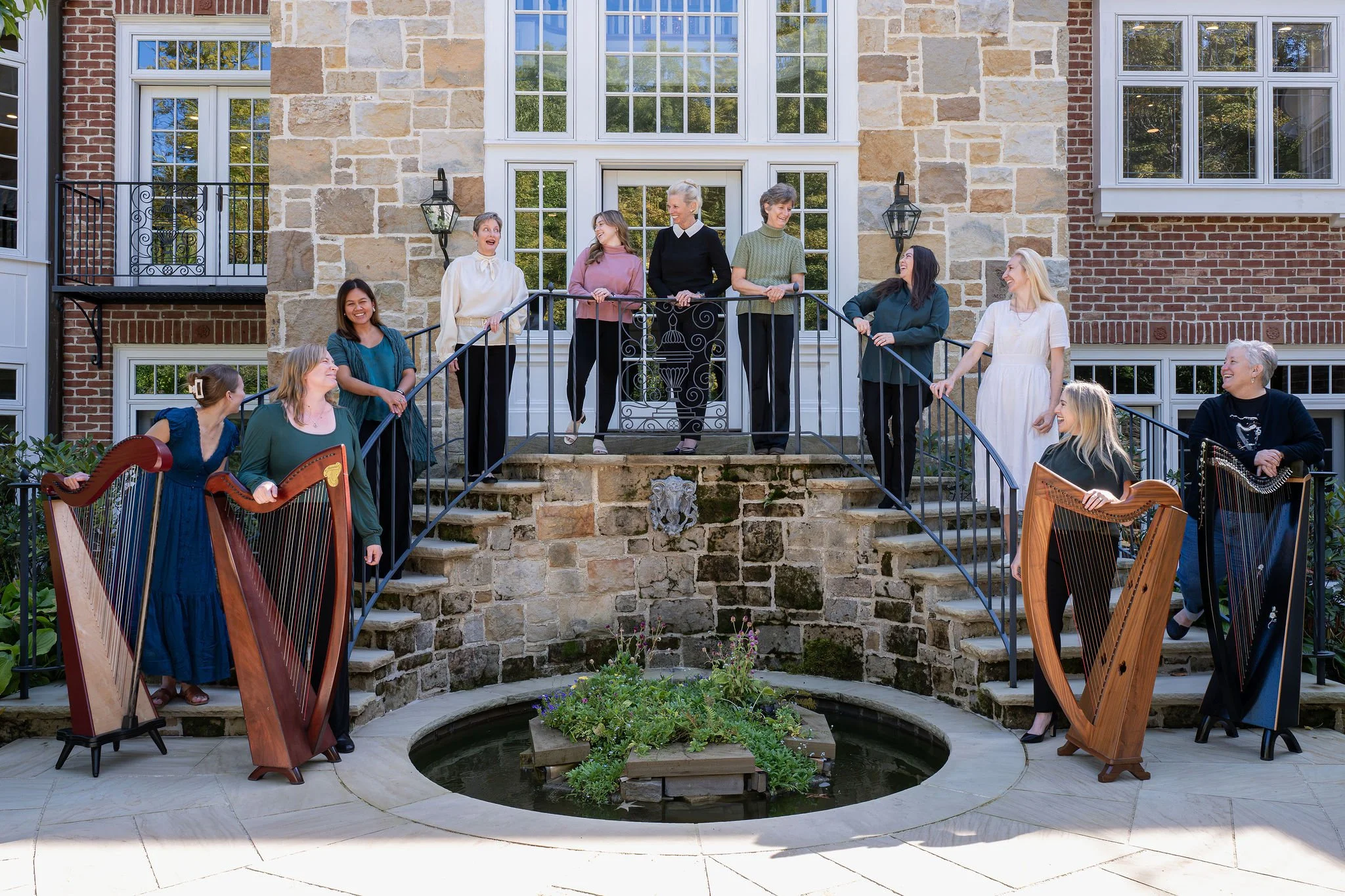
The Cleveland Harp Circle was founded in 2025 in Cleveland, Ohio by a group of pedal, lever, and historical harpists. Our members include those just beginning their harp journeys, as well as teachers, therapeutic musicians, award-winning folk musicians, and harpists who have performed on international stages.
Eligibility
Open to composers worldwide who are age 18 or older at the time of submission. Prior experience composing for harp is not required.
Application Requirements:
Up to 250 words describing the thematic material or narrative you might explore if selected, as well as your approach to this project. What approaches to composing for harp ensemble might you take? What experience, if any, do you have composing for harp or collaborating with harpists? (Prior experience is not required).
One page minimum sample of a musical score introducing musical/thematic elements salient to your proposal and techniques you might employ
Link to a portfolio of at least two works demonstrating your compositional strengths, each with a PDF score and an audio recording or MIDI playback.
Resume (pdf or doc)
Contact information: Name, Email, Phone, Mailing Address
Deadline for Proposals: Dec. 15, 2026
Questions? contact newmusic@clevelandharpcircle.org
Timeline of Project
Open Call for Composers launches: October 17, 2026
Deadline for Proposals: 11:59pm EST, December 15, 2026
Winner notified: January 15, 2027
First draft deadline: February 15, 2027
Final delivery deadline: March 15, 2027
Musical specifications for the Commissioned work
Our commissioning project intends to create new works for harpists of varying ability and experience.
The work will:
Be approximately three minutes in duration;
Contain four core independent harp parts, with additional optional parts welcome;
Be playable in its four core parts on 34-string lever harps, with no core part requiring more than 34 strings or the use of pedals. Optional material for larger lever harps or pedal harps may be included;
Include at least one core part suitable for an advanced-beginner harpist;
Include at least one core part playable in full on a 26-string lever harp (this can also be suitable for the advanced-beginner);
Include at least one core part geared toward more advanced players;
Permit additional optional parts written specifically for pedal harp, or other types of harp
See below for notes about composing for this project
Deliverables
If selected, the composer will provide:
A PDF of the full score + individual parts. These should be legibly engraved for performance.
Source notation file of the final draft [e.g. Dorico, Sibelius, Musescore] for engraving purposes in our collection
1-2 minute video program note, introducing the piece for social media
Short performance note for inclusion in the collection
Composer bio [150 words]
Composer Headshot
Rights and Licensing of Selected Works
The following terms are anticipated to apply to works selected for the Cleveland Harp Circle collection, subject to execution of a separate Composer Commissioning and Licensing Agreement:
Publication and Distribution: If a work is selected and the Composer Commissioning and Licensing Agreement is executed, CHC may publish, distribute, maintain, and archive the score and parts as part of the Cleveland Harp Circle collection, including on its website, in educational materials, archives, and other nonexclusive repositories, in accordance with the agreed licensing terms.
Commission Credit: CHC may identify the work as a Cleveland Harp Circle commission in perpetuity.
Licensing: The work will be made available under the Creative Commons Attribution-NoDerivatives 4.0 International (CC BY-ND 4.0) License. Any additional permissions, including uses not authorized under that license, will be governed by the Composer Commissioning and Licensing Agreement. Additional permissions and licensing rights may include print and digital sheet music licensing, synchronization, mechanical licensing where applicable, grand rights, arrangements or adaptations, and other authorized uses, as provided in the separate Composer Commissioning and Licensing Agreement. Such permissions will be granted without additional licensing fees payable by CHC or users who download the Work from CHC's platform. Composer will remain responsible for registering the Work with applicable rights organizations and administering and collecting any royalties to which Composer may be entitled.
Compensation: The selected Composer will receive a commissioning fee of $2,500, payable in two installments: $1,250 upon execution of the Composer Commissioning and Licensing Agreement and $1,250 upon CHC's acceptance of the completed Work.
Copyright Ownership: Composer retains all copyright ownership and authorship of the work. No copyright ownership will be transferred to CHC.
Performing Rights: Composer retains responsibility for affiliation with and registration of the work with the applicable performing rights organization (PRO), as well as the administration and collection of any public performance royalties payable to Composer.
Some notes about composing for the Cleveland Harp Circle:
Our harpists use 4 fingers on each hand.
Harps can be played melodically as well as chordally, and scores are typically set up with a treble and a bass clef (similar to piano), where the treble is typically the right hand and the bass is typically the left, but each hand has access to nearly the full range of the instrument. (Low notes become further away for the treble hand the more strings are on the harp).
While electronics, video elements, projection, and amplification are all possible—and imagination is most welcome—assume limited time in terms of setup or “prepared” harp.
For this project, assume lever harps are tuned to Eb major. This means, with all sharpening levers down, the key is Eb major; with all the sharps up, it is E major. Please compose a piece with no more than 3 flats or 4 sharps, being mindful of accidentals within this framework (i.e. using enharmonics to represent notes beyond 3 flats or 4 sharps).
Each string is only able to be sharpened one semi-tone. Levers are independent from each other, meaning sharpening C4 to C#4 will not affect other C strings up and down the instrument. Neighboring levers can possibly be sharpened together (Eg. F#5/G#5), but keep in mind that sharpening a lever requires removing a hand from the harp, typically the left hand, and only very rarely the right hand (which has to jump over the top of the harp). There are various ways to show “when” to move the levers, which can be discussed during the first draft editing period.
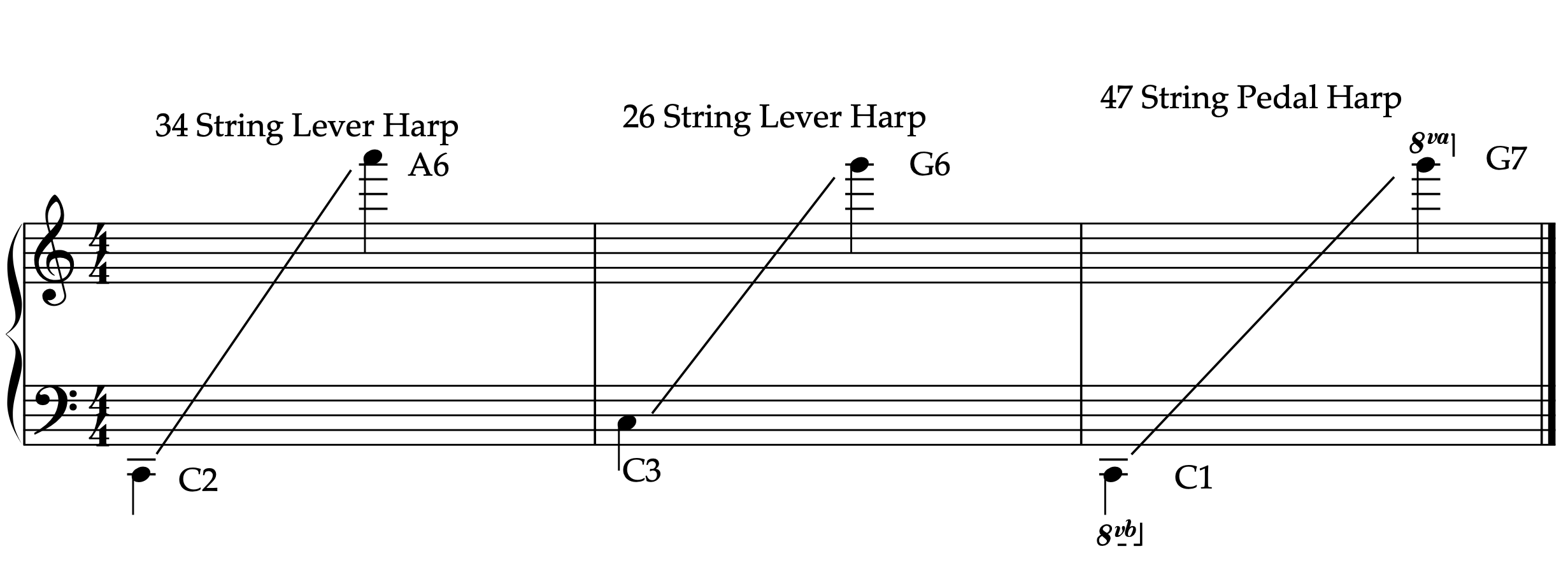
Typical ranges of harps (keeping in mind that one part must be for the 26 string harp). Feel free to compose “ossia” sections for pedal harp that can be reduced to the “core” part with no more than 34 strings.